Law firm AI efficiency: Who captures the savings?

Law firms are using new AI-based technology to complete certain phases of work more quickly. Research cycles move faster – reportedly cutting research time by 60%. Document review is more consistent. Drafting takes less time. Many firms report meaningful productivity gains.
So, do their clients benefit from this? It doesn’t look like it.
Rates continue to rise and billing patterns often look the same as they did before these tools were adopted. In 2025, outside general counsel rates increased by around 9%, with Global 50 firms averaging 13.5%, and partner rates climbing as high as 17.4%.
Firms have said the rise in external legal costs equals a median 0.19% of company revenue, and for the largest enterprises this can exceed $50 million a year.
And when the work accelerates but spend continues on the same path, legal leaders focus on a simple question: where is the efficiency going?
This is why the efficiency question is rising quickly. As technology reshapes how matters progress, in-house teams want earlier clarity on how those gains influence value and whether they are reflected in the work being delivered.
In this article:
|
Why AI-enabled efficiency is becoming a value issue
AI is changing how legal work is carried out, but it is not changing how clients see value. This creates a growing concern in legal spend management. Productivity improves inside the workflow, yet the billing picture that reaches in-house teams looks the same. To understand whether efficiency is improving outcomes, legal leaders need insight into how matters progress long before invoices arrive.
Efficiency changes where effort sits inside a matter.
AI does more than speed up tasks. It changes how work is distributed across a team. Routine tasks compress. Senior review increases. Entire phases progress with a different balance of expertise.
For in-house teams, traditional indicators of value in legal billing accuracy become harder to interpret. Hours, staffing, and role mixes reveal less about how effort was applied. Invoices record activity, but not the reasoning or sequencing behind it. As more work is automated, the economic signals inside the bill provide less guidance.
Matters progress faster than in-house teams can intervene.
When certain tasks move quickly, key decision points move with them. Matters advance before clients have time to engage. Variance becomes visible only after it has compounded across several phases.
This is a recurring challenge in outside counsel management. Without visibility into how a matter develops, clients cannot tell whether efficiency supports better outcomes or creates new pressures elsewhere.
Critical decisions about AI aren’t visible to clients.
Firms are making more decisions about where legal AI software should be used and how much human oversight is needed. Some decisions reduce effort. Others increase it. None are visible until billing arrives.
This creates uncertainty even when the work progresses smoothly. In-house teams want to understand how these decisions influence quality, risk, and the choices firms make during the matter. Standard billing cannot answer those questions. More reliable indicators are needed to evaluate value while the work is ongoing.

Why rising rates and unchanged billing patterns intensify the tension
Rising rates would be easier to accept if billing patterns showed signs of improved efficiency. Instead, clients see the opposite. Rates climb each year while the underlying structure of the bill remains familiar. Partner involvement increases. Blended rates move upward. Hours recorded across phases often mirror previous matters. Efficiency inside the workflow is not visible at the client level, which creates pressure for stronger evidence of value.
1. Rate increases now outpace internal productivity improvements
Recent rate data shows partner and associate increases well above inflation. These increases land at the same time firms report meaningful gains in productivity. When the cost of senior time rises faster than the underlying effort required to deliver the work, in-house teams look more closely at the connection between price and value.
2. Bills reflect historical staffing models (not new efficiencies)
Many invoices still display staffing patterns optimized for pre-AI delivery. Partner-heavy involvement, repeated review cycles, and familiar levels of junior support appear even when certain tasks now require less effort. Without visibility into how those decisions were made, clients cannot understand whether the staffing mix is appropriate or simply inherited from older models.
3. AFAs are not immune
Even fixed fees and phased arrangements can show the same issue. Faster tasks compress timelines, but the agreed fee remains unchanged. Without insight into the work behind the fee, clients cannot tell whether the arrangement reflects actual efficiency or whether early gains are absorbed by later phases that expand to fill the budget.
4. Variance becomes visible too late
The first indication that costs are rising often arrives only when the bill does. By that point, the value conversation becomes retrospective. In-house teams are left reviewing what happened instead of influencing what happens next. Rising rates amplify this problem because each late discovery has a larger budget impact.
You can start to see why rising rates feel increasingly disconnected from how the work is actually produced, and why clients are asking for clearer evidence that efficiency is reaching them.

Where efficiency gains sit inside the workflow and why clients cannot see them
AI speeds up certain tasks, but the way that speed appears inside the workflow is rarely visible to clients. Most of the effect shows up in how teams organize work, how they maintain quality, and how they make decisions as a matter progresses. These are important drivers of cost and value, yet they never surface through standard billing.
Here’s why:
➡Faster work changes the pace and structure of matter progression
When early tasks move quickly, the overall flow of the matter changes. Teams move from one stage to the next sooner, leaving fewer natural points for clients to check progress, confirm assumptions, or adjust scope. Traditional milestones become less reliable as indicators of how the work is unfolding.
➡Quality controls happen early and leave no clear record
AI reduces repetitive checking, but it also introduces earlier rounds of verification. Teams perform comparisons, consistency checks, and internal review before anything is shared externally. These steps influence the overall effort, yet they leave no trace that clients can see. The bill reflects activity, but not the reasoning behind it.
➡Scope adjustments occur during the work, not at formal checkpoints
Early insights often surface issues sooner in the matter. A clause requires additional work. A diligence point requires more analysis. A regulatory change prompts further review. Each adjustment adds work, but because it occurs during the workflow rather than at formal stage gates, clients do not see the rationale until billing arrives.
➡Risk management changes as tasks accelerate
When work moves faster, the risk pattern changes. Some risks reduce because issues appear earlier. Others increase because accelerated work requires additional confirmation. These shifts influence effort, yet invoices only show the final hours, not how teams balanced speed and caution.
➡Billing systems record outputs only
Invoices summarize time by phase and role. They do not show why certain reviews were necessary, how teams organized the work, or which decisions required additional attention. They cannot distinguish between essential effort and effort that emerged because the workflow accelerated.
To sum up: The important decisions and adjustments occur inside the work itself, long before the invoice. Without visibility into those moments, clients cannot see how efficiency affects cost, pace, or value. But this can change.
How continuous spend visibility reveals the impact of AI before billing
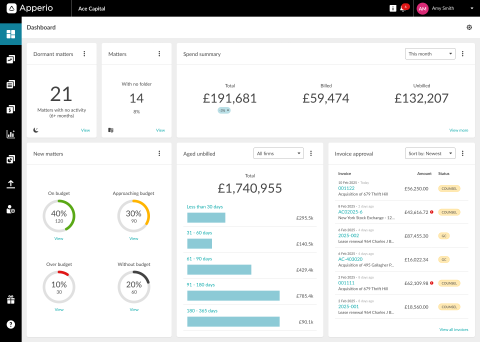
Invoices arrive after the work is complete, which means the most important decisions shaping cost and value stay out of view. Continuous spend visibility changes that. It brings the work itself into focus and lets in-house teams understand how matters are progressing while there is still time to influence the outcome.
Below is a comparison showing how matter oversight works today versus how it functions when clients use Apperio for continuous spend visibility and structured engagement through PERSUIT.
| Without continuous spend visibility | With continuous spend visibility through Apperio + PERSUIT |
| Work progresses with limited context. Clients see only the final hours recorded. | Activity is visible as it happens. Clients see how time is being used across phases and roles. |
| Scope changes appear only once billing catches up. | Adjustments become clear midstream, allowing early conversations before costs build. |
| Faster phases create uncertainty rather than clarity. | Early completion of tasks signals where efficiency is occurring and how it affects the matter. |
| Billing reveals staffing decisions after the fact. | Teams can see which roles are engaged at each stage and whether patterns match expectations. |
| WIP risk accumulates quietly inside the workflow. | Variance is flagged in almost real time, giving clients a chance to intervene before cost paths harden. |
| Firms provide explanations only after the invoice. | Firms and clients align on the evidence while work is ongoing, strengthening trust and predictability. |
| Fixed fees mask effort until the matter concludes. | Live data shows how work is tracking against the agreed scope and pricing assumptions. |
| Value discussions happen retrospectively and feel defensive. | Conversations become forward-looking, grounded in shared facts and progress data. |
PERSUIT defines the starting point by structuring scope, pricing expectations, and matter assumptions. And Apperio provides the in-progress view that shows how the work is unfolding against those expectations.
This gives legal leaders visibility into the entire lifecycle:
- clear scope at the outset
- live oversight midstream
- firm understanding of value at the close
This reduces friction, strengthens relationships, and gives in-house teams confidence that efficiency is supporting the right outcomes.
Bring efficiency and value into clear view in legal spend management
AI is improving the speed and consistency of legal work, but the benefits only become meaningful when clients can see how that progress is achieved while the work is still underway. Invoices arrive too late to provide that clarity. A continuous view of spend (as it happens) brings underlying decisions, staffing patterns, and pace into focus, giving in-house teams the context they need to understand value as the work develops.
When that visibility is paired with structured scoping and pricing at the outset, legal teams gain a complete view of how work is delivered and whether efficiency is supporting the intended outcome. This creates a more predictable operating model, reduces friction with firms, and gives leaders the confidence to manage spend with greater precision.
As technology becomes more embedded in legal delivery, the firms and clients who rely on a shared and continuous feed of spend information will be better equipped to manage both cost and value as the pace of work continues to increase.
If you want clearer insight into how a continuous view of spend visibility can improve accuracy, predictability, and the value you gain from outside counsel, we can help.
See how Apperio and PERSUIT support in-house teams with clarity from scoping to final billing. Book a demo.
Author:

Dominic Aelberry
CEO