Are legal teams measuring spend but sacrificing quality in outside counsel management?

Most legal departments can report exactly how much they spent with each firm last year, and many now rely on legal spend analytics to do it. In fact, 87% track total spend by law firm. But far fewer can say whether that spend delivered the result the business needed, with only 20% tracking the quality of legal outcomes.
That imbalance creates a bit of an issue: When the only information legal can bring to Finance is cost, every discussion leans toward expense rather than performance.
Moreover, as outside counsel rates continue to rise, this issue becomes even more visible. Without a way to understand quality during the matter, legal teams are left managing backwards: reviewing invoices, validating scope long after decisions were made, and trying to explain outcomes using data that was never designed for that purpose.
For teams aiming to operate as strategic partners, this restricts their ability to demonstrate impact. They need information that shows what was spent and what was achieved, and they need it while the work is in progress.
What this article covers:
- Why legal spend analytics provide only part of the picture when evaluating outside counsel
- The early WIP indicators that reveal delivery issues, including staffing, scope, and quality signals
- How continuous matter data improves performance visibility without adding administrative work
- How Apperio and PERSUIT connect scoping, delivery, and billing to support better decisions
Why legal spend analytics don’t show the full picture of outside counsel performance
Most legal departments have strong spend reporting. Systems capture hours, rates, accruals, forecasts, and variances, so questions about cost are easy to answer. Teams can see which firms received the most work, which matters absorbed the largest budgets, and how actuals compared with forecasts.
And that’s because spend fits neatly into financial systems. Those systems are designed to track cost, and over time legal has built reliable tools around them.
But what these systems cannot show is how the work was delivered. They do not reveal whether the matter moved at the pace expected, whether staffing stayed aligned with the plan, or whether the work supported a business priority. Those details sit inside the day-to-day activity of the matter rather than in invoices or summary reports.
Spend can be explained in detail, while performance needs to be inferred. Even when invoices are disputed or adjusted, the numbers can usually be reconciled. Challenges begin when teams try to answer questions that sit outside the financial record, like:
- Was this the right firm for the work?
- Did the matter progress in a way that reflects sound project management?
- Were senior lawyers involved in the right places?
-
Did the work support the timeline or objective that the business required?
These questions rely on information from the matter lifecycle, not only the billing system. Without that context, legal is left speaking in financial terms when the business wants clarity on outcomes. Finance sees cost; the department sees how the work unfolded; neither view on its own explains value.
When legal can see both cost and delivery, firm performance becomes easier to judge. That is the level of visibility most teams need but rarely have.

Why a spend-only view weakens outside counsel management
Two matters can carry identical costs while progressing very differently. One firm may keep the work on track with the right staffing and clear coordination. Another may generate rework, bring in senior lawyers where they are not needed, or move more slowly than expected. The numbers look the same even when the experience does not.
This matters because decisions about outside counsel depend on how the work is handled, not only on what it costs. Without visibility into delivery, legal has limited evidence when explaining why one firm is a better fit for a type of matter or why another consistently requires more oversight.
Timing is another limitation. When spend is the only indicator, issues surface late, often when invoices arrive. By then, staffing decisions are already embedded, scope has moved, and the matter has absorbed more cost than expected. Without in-flight visibility, any course correction depends on anecdotal updates rather than reliable information.
Outside counsel management improves when legal can assess spend and delivery together. Cost explains one part of the matter. Delivery explains the rest. Leaders need both to make informed decisions about panels, pricing, and staffing with confidence.
5 core quality indicators for effective outside counsel management
Quality is often discussed in broad terms, but in day-to-day practice, it shows up in clear and observable ways. It becomes visible in how the work progresses, how teams coordinate, and how closely firms follow the expectations that were agreed. When legal teams can see this activity, quality becomes easier to judge with confidence.
1. Consistent progress across each stage of the matter
High-quality work moves at a steady pace. Tasks advance in the expected sequence, key phases close on time, and the staffing plan stays intact. Coordinated workstreams reduce the need for intervention and limit the risk of delays.
2. Effective coordination and clarity of ownership
Quality is reflected in how cleanly the work is managed. When roles are clear, updates are timely, and handoffs are smooth, matters require less oversight. Good coordination keeps legal informed and gives internal stakeholders a predictable experience.
3. Responsible use of professional judgment
Experienced teams anticipate when scope may need adjustment and raise it early. They explain the implications, help internal teams prepare, and prevent hours from building unexpectedly. This level of judgment builds confidence throughout the matter.
4. Early indicators of strain or inefficiency
Lower-quality delivery becomes visible through slower progress, unclear ownership, or unexpected changes in who is doing the work. Senior contributors may take on tasks suited to junior lawyers, or multiple people may record time on the same activity without a clear reason. These situations create uncertainty even when spend looks stable.
5. Clear evidence of where value was strengthened or diluted
These operational details reveal whether the firm managed the matter with discipline, whether staffing supported the work, and whether delivery stayed aligned with expectations. They point directly to where value was created or lost, which is essential for understanding performance.
These points give Legal a clearer way to judge quality by looking at how the work actually progressed. They also prepare the ground for the indicators visible in WIP, where early signs of performance appear while there is still time to act.

Early indicators of lower-quality work: What WIP reveals before the invoice
Live WIP is often seen as a budgeting tool, but its real value lies in the visibility it gives legal teams into how the work is being delivered. It highlights early signs of delivery issues that never appear in spend reports or invoice-stage reviews. When legal can see this activity during the matter, quality becomes something they can assess in time to act on it.
Seniority misalignment: unnecessary partner involvement
One of the clearest indicators appears when senior partners record time on tasks that do not require that level of experience. As Duncan Williams General Counsel for Nuclear Fuel, Westinghouse, raised in a recent webinar with us: the ability to look at WIP and ask, “Why is this partner time?”.
This is more than a cost concern. It shows whether staffing is aligned with scope, whether the team is using the right mix of contributors, and whether the firm understands the expectations set at the outset. Unnecessary senior time slows progress and affects efficiency.
Stacking: multiple contributors on the same task
WIP also reveals when too many timekeepers participate in a single activity. Williams also noted this during the webinar: partner stacking on routine calls or reviews can become a pattern if no one is watching the matter as it unfolds.
This often indicates duplication, unclear ownership, or internal coordination issues. It can slow progress because more contributors mean more communication points and more oversight from the in-house team.
Hours rising without corresponding movement in the matter
Another early sign appears when WIP shows rising hours without visible movement in the underlying activity. This may point to rework, uncertainty about next steps, or lack of clarity in how tasks are sequenced.
These situations affect the timeline of the matter and create risks for internal stakeholders who depend on steady progress.
Unplanned changes to the staffing mix
When new contributors appear in WIP without a change in scope or workstream, it suggests the firm is adjusting the team reactively. These changes often lead to extra onboarding time, uneven quality, or inconsistent assumptions.
They are difficult to detect through invoices alone. WIP surfaces them as they happen.
Activity that does not match the agreed scope
WIP highlights when activity begins to diverge from the expectations set at the start of the matter. This includes time recorded on tasks that were not discussed, work that should have paused, or hours that exceed early assumptions for a phase.
Scope movement is one of the earliest predictors of budget deviation and is easiest to address when seen early.
Why these indicators are a must-have for value and decision-making
Seeing early delivery signals in WIP gives legal a clearer view of how a matter is progressing and whether the firm is meeting expectations. With that visibility, teams can explain performance more confidently and understand where the work supported — or strained — the business.
This insight also strengthens future decisions. Firms that manage matters will stand out when their delivery is visible, which helps legal allocate work with more certainty. The same visibility improves forecasting because leaders can see the pace of each phase and anticipate issues early rather than at month-end.
And when concerns do appear, they surface in time to address them. Seniority drift, unclear ownership, or unplanned staffing changes can be corrected while the work is still moving, which helps control cost and maintain alignment.
Most importantly, these indicators help legal describe value in terms the business recognizes. Spend explains what was paid. Delivery explains why. Leaders need both to assess outside counsel with confidence.
How lifecycle data strengthens outside counsel management and legal spend analytics
Legal teams make better decisions when they can see how work is scoped, staffed, delivered, and billed. Many departments have strong financial reporting but limited visibility into the day-to-day activity behind the work. That lack of visibility affects how performance is understood and how future work is allocated.
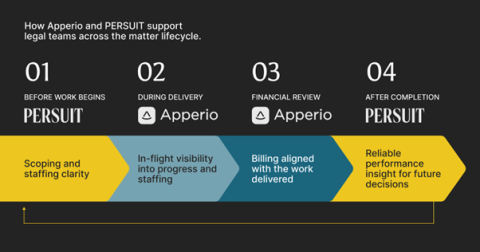
PERSUIT and Apperio address this by giving legal clearer information at the points where it has the most influence. Each platform supports different stages of the matter lifecycle and helps leaders build a more reliable view of outside counsel performance.
1. Before work begins: Scoping and staffing clarity
Early decisions set the tone for how a matter progresses. A clear scope, defined staffing expectations, and informed pricing create a stronger starting point.
PERSUIT supports this stage by helping legal and firms align on the assumptions that guide the work. When both sides begin with the same expectations for scope, staffing, fees, and timelines, the matter opens with far less uncertainty.
2. During delivery: In-flight visibility into progress and staffing
Once the work is underway, legal needs to see how activity is progressing. Leaders want to know whether the matter is moving at the expected pace, whether staffing is aligned with the plan, and whether any early signs of strain are developing.
Apperio provides this in-flight visibility. Continuous insight into WIP, progress, budget position, and staffing activity shows how the work is unfolding. Issues such as seniority drift, unclear ownership, or scope movement become visible while they can still be addressed.
3. Financial review: Billing aligned with the work delivered
Billing is easier to evaluate when the underlying activity is already known. Legal needs confidence that hours, staffing, and scope reflect what was agreed at the outset.
Apperio supports this stage by allowing invoices to be checked against a complete activity record. Instead of reconciling a retrospective summary, legal reviews billing alongside what they have already observed throughout the matter.
4. After completion: Reliable performance insight for future decisions
A clearer view of the lifecycle helps legal understand the overall experience of the matter, not only its cost. Leaders see which firms delivered well, where staffing supported the work, and what conditions contributed to better outcomes.
PERSUIT strengthens the beginning of the lifecycle. Apperio strengthens the middle and end. With both in place, legal teams gain a reliable view of performance across all stages of the matter.
To sum up: This level of visibility gives legal a clearer foundation for decision-making. Leaders can assess performance with confidence, explain value in ways the business recognizes, and guide future work using evidence rather than retrospective summaries.
A clearer way to understand performance in outside counsel management
Spend reporting shows what was paid, but it does not explain how the work progressed or whether the firm supported the business in the way that was expected. Quality becomes clearer when legal can see how the work moved through each stage, how the team was staffed, how scope was handled, and how internal stakeholders were supported.
When this activity is visible, performance is easier to assess. Legal can explain how value was created, understand where delivery did not meet expectations, and plan future work with a clearer view of which firms consistently support their goals.
Stronger visibility at the start of the matter and throughout delivery gives legal a better foundation for decisions. Leaders can intervene earlier, forecast with more certainty, and guide the business using evidence the organization trusts.
When legal teams can see both spend and the work behind it, they can manage outside counsel with greater clarity and confidence.
See how Apperio and PERSUIT improve visibility, performance, and control across every matter. Book a demo.
Author:

Dominic Aelberry
CEO