How standard rate increases undermine negotiated discounts

Most legal teams think they have a clear way of managing outside counsel costs. Discounts are negotiated, agreed, and then applied across firms and matters. This approach makes sense. It creates consistency. Over time, you build a view of what work should cost and how firms are expected to price.
But when you look at recent rate reviews, costs are going up, even where discounts have been held in place. In the US, average increases are still landing above 12% after negotiation, while discounts sit in a relatively narrow range.
Negotiation is happening. Discounts are being applied. And the total cost is still higher.
You see it when you compare similar work year to year. The scope is the same. The firms are the same. The discount is unchanged.
The difference lies in the rates at which those discounts are applied. And this is a common issue in legal spend management, where pricing appears stable but underlying costs continue to rise.
Key takeaways from this article:
|
Why negotiated discounts often remain stable year after year
This usually starts with how discounts are set and carried forward.
Discounts have become embedded in panel and guideline structures
Once discounts are agreed, they tend to stay in place.
They are set during panel selection, rate reviews, or guideline updates, and then applied across future work. The same percentages carry through from one instruction to the next, often without much change.
They are not usually revisited unless something prompts it. A panel refresh. A change in firm performance. A broader review of outside counsel strategy.
Until then, they hold.
Market data shows discount clustering
The same thing shows up across the market. Discount levels sit within a fairly narrow range. According to PERSUIT’s 2026 Outside Counsel Rate Trends report, in the US, the average discount is 16.6%. In Europe, it is 17.2%. In the UK, it is 20.6%.
After a while, that becomes the norm. Discounts are no longer much of a factor from one relationship to another. They are simply part of how firms are engaged.
Stability creates confidence
With that consistency in place, pricing starts to feel predictable. The same firms are used. The same discounts apply. There is a shared understanding of how work is priced, based on what has been agreed before.
That expectation builds over time, because the same discounts are applied each time new work is sent to the same firms.
What’s underneath that consistency
The discount isn’t what drives the final cost. The rate is.
When the rate goes up, the price goes up. The discount can stay exactly the same. And those changes don’t come through renegotiation. They come through annual rate increases.
Across the data, both are happening at the same time. Discounts remain broadly where they are, while underlying rates continue to move.
To sum up: Discounts create consistency in how firms are engaged. They do not keep pricing fixed over time.

How law firms reset standard rates instead of discount levels
If discounts tend to stay where they are, the next thing to look at is what actually changes over time.
Standard rates are the primary pricing lever
Firms review and adjust their standard rates each year. Those increases come through as part of the normal rate cycle, rather than as part of a wider renegotiation. The discount often stays the same. The underlying rate increases. The final price moves with it.
Across the data, discounts remain broadly consistent, while net rate increases still land in double digits after negotiation.
Firms increase rates. The cost follows
Firms increase standard rates, and the final cost moves with it. A 20% discount applied to a higher rate produces a higher final number. That is straightforward, but it is easy to overlook when the discount itself has not changed.
Over time, those increases add up. A few percentage points each year is enough to move the cost of similar work when you compare it over a longer period.
The discount is unchanged. The total cost is not.
Rate increases are not limited to the top of the market
This is not limited to the largest firms. Rate increases are showing up across the market, including firms outside the top tier. In some segments, mid-tier firms are increasing rates at a similar pace to larger firms.
And that has an impact on how work is allocated. Moving work to a different group of firms does not reduce exposure to rate increases in the same way it once might have.
Key takeaway? When standard rates increase, the final cost increases with them, even if the discount remains the same.
Why discounts can create the illusion of pricing discipline in legal spend management
Discounts are easy to report but they are incomplete. They are often used as a signal that pricing is under control. And they make you feel like you’ve secured a good deal. But you haven’t.
A consistent discount across firms suggests consistency in how those firms are managed.
You might see this in a review and feel comfortable with it. The same percentage appears across the panel. It has not changed much over time. So, on that basis, it looks like pricing has held steady.
But digging into the numbers shows something else. The discount sits on top of a rate. When that rate increases, the final price increases as well. The percentage on its own does not show how that underlying number has moved.
And negotiation outcomes reinforce the illusion. Firms often start with a higher proposed increase and then adjust downwards during the discussion. The final number is lower than the starting point, which gives the sense that something has been gained.
Even so, the outcome still ends up above the previous year. In the US, initial rate requests average around 20%, with final agreed increases still landing above 12% after negotiation.
So the negotiation has an effect, but the overall legal cost still increases. And, over time, this becomes visible when you compare similar work across different years.
The same firms are used. The same discounts apply. The totals are higher.
To sum up: Discounts show how pricing compares to a firm’s stated rates. They do not show how those rates change over time.
What legal teams should monitor instead of headline discounts
Discount levels on their own don’t give a clear view of legal spend management.
Here are a few areas that tend to give a more accurate picture of how pricing is changing.
- Effective rates over time: Rather than focusing on the agreed discount, look at what is actually being paid. Blended rates across firms and types of work tend to show movement more clearly, especially when tracked over longer periods.
- Rate of change across similar work: Comparing like-for-like work year to year can be more revealing than looking at averages. It shows where costs are increasing, and whether that increase is consistent or concentrated in certain areas.
- Seniority mix and partner exposure: Changes in who is doing the work can have a noticeable impact on cost. A small increase in partner time, or a shift in how work is staffed, can move the overall price even if rates themselves have not changed significantly.
- Spend during the course of the work: Looking at costs while work is ongoing, rather than waiting for invoices, makes it easier to see whether things are tracking as expected and gives more time to respond if they are not.
Looking at these together gives a clearer view of what is driving legal cost. When pricing, staffing, and spend can be seen as work progresses, it is easier to understand what is driving changes in cost.
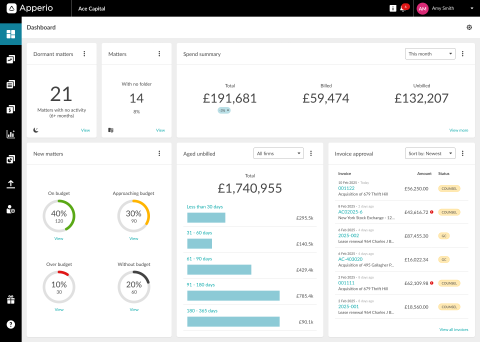
This is the kind of visibility Apperio is built to provide. You can learn more here.
How pricing governance protects long-term spend predictability
Most pricing outcomes are already shaped before any rate discussion begins.
They sit in how work is scoped, how rates are structured, and how staffing is expected to be used. Where those are loosely defined, firms have more room to move. Where they are set upfront, that room is narrower.
Stronger programmes address this early. Expectations are set at the outset, rather than adjusted later.
From there, the focus is on whether work is tracking as expected. Changes tend to come through in familiar ways, like more senior involvement, different staffing, additional work. Left alone, they accumulate.
Seeing that while work is ongoing makes a difference. It allows teams to step in before those changes are reflected in the final cost.
Over time, this changes how pricing is managed. It becomes something that is shaped before work begins and monitored as it progresses, instead of once a year.
Where pricing control actually sits
Discounts still have a role. Most teams have them in place, and they tend to hold. But they sit on top of rates that continue to move.
That’s why pricing can appear stable while costs increase over time.
The teams that manage this well look beyond the discount. They track how rates, staffing, and spend evolve across similar work, and they pay attention while work is still underway. And that is where pricing control in legal spend management actually sits.
This is also where the connection between pricing and spend becomes clearer. Expectations are set at the point of engagement, and then tracked as work progresses, making it easier to see how those agreements translate into actual cost.
If you want to see how this looks in your own data, you can learn more about Apperio here.
Author:

Dominic Aelberry
CEO