Moving work to cheaper firms doesn’t always reduce legal spend

Across the market, rate increases are no longer confined to the top tier. Firms at every level are pushing pricing upward, while discounts remain broadly consistent year to year.
The pricing difference between firms still exists, but it is no longer widening in a way that reliably delivers savings. As a result, many legal teams are finding that moving work down-market does not consistently lower legal spend costs as they’d expect.
That’s because the drivers of cost sit deeper than firm selection, in how the work is delivered over the life of a matter. A relatively small group of senior lawyers can drive disproportionate cost exposure, regardless of firm tier.
Firm selection still influences price, but it is no longer where cost is determined.
Key takeaways from this article:
|
What’s actually happening in the outside counsel market
Typically, in outside counsel management, the assumption that lower-tier firms deliver materially lower outcomes relies on pricing differences holding steady over time.
But that is no longer what the data shows.
According to PERSUIT’s 2026 Global Outside Counsel Rate Trends report, rate increases are showing up consistently across firm segments, not just at the top end. In the US, average year-on-year increases are still landing above 12% even after negotiation, while discounts remain clustered in a relatively narrow range of around 16–17%.
Looking more closely at how different segments are moving:
- AmLaw 1–50 firms are still pushing significant increases, averaging 15.8%
- Firms ranked 51–100 are not far behind, with increases of 12.7%
- Even firms outside the top tiers are continuing to move upward, with increases above 10%
At the same time:
- Discounts remain broadly consistent across the market, typically sitting in the mid-teens regardless of firm position
-
Negotiation reduces initial rate requests, but still results in net increases of around 12% year-on-year
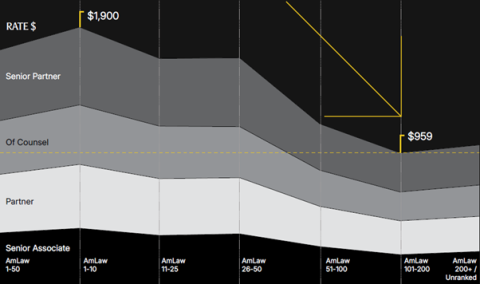
And this changes how reallocation works.
If rate increases are happening across all segments, and discounts are not widening to compensate, the relative pricing difference between firms becomes less effective as a cost lever.
You can see this most clearly in the middle of the market. Firms are not maintaining distance from those above them. They are moving upward, responding to the same pressures and resetting pricing expectations.
Cost is also set by how pricing is structured
The market data explains why reallocation is less reliable. But it’s not enough, and we need to do more to understand what’s actually driving outcomes.
Nowadays, pricing is no longer primarily shaped through negotiation. It is being set through how rates are established and carried forward across engagements… Which brings me to the next point.
Standard rates are doing more of the work
Discounts tend to draw the most attention. They are visible, negotiated, and easy to compare. But they are not where pricing pressure lies.
What’s also crucial to note is the rate at which those discounts are applied. As standard rates increase, they reset the baseline for future work. That baseline carries through, regardless of which firm is selected or how consistent discount levels appear.
And, over time, that has a compounding effect on overall cost.
So, discount levels appear stable, but the underlying pricing continues to move.
Negotiation is narrowing the increase, not changing direction
Negotiation still has a role, but it is operating within tighter boundaries. Firms are setting higher starting points, and while negotiation reduces those initial positions, the final outcome still reflects a year-on-year increase.
As a result, negotiation is reducing the size of the increase, rather than determining whether it happens.
Pricing expectations are being reset across the market
Pricing is not set in isolation. Firms respond to each other, to client demand, and to broader cost pressures. Meanwhile, those adjustments accumulate across the market. Over time, they reset expectations for what similar work should cost, regardless of where it is placed.
That makes it harder for reallocation alone to change the overall trajectory of spend.

Why switching firms doesn’t reliably change outcomes
It was only last week that this very topic came up, prompting me to write this article.
I was speaking to a senior legal leader recently who described a situation that will sound familiar. They had moved a piece of work to a lower-cost firm. The scope was clear, the rates were agreed, and on paper, it looked like a straightforward way to bring costs down. But by the time the work was complete, the savings they expected hadn’t materialised.
As they put it, nothing had gone wrong. The legal work just unfolded differently.
A senior lawyer stayed closer to the details than expected. The analysis went deeper as new issues came up. Extra review was added along the way. Each decision made sense at the time.
But the outcome was different.
That’s because the same work can produce very different results depending on how it is delivered. Changing the firm doesn’t necessarily change the outcome. Even within the same firm, costs can vary from one engagement to the next.
The difference wasn’t the firm. It was how the work was carried out. And this is what we discussed as a solution...
What effective outside counsel management focuses on instead
A lot of attention still goes into firm selection. But the data shows that cost is often shaped elsewhere.
Instead, firms need to look at the drivers of legal spend. And for that, they need to set clearer expectations at intake and also gain greater visibility of spend as matters progress.
Start with outside counsel selection
The most effective teams treat selection as the starting point. They define expectations clearly at intake, so there is a shared understanding of how the work should be delivered before it starts.
That includes:
- how the work should be staffed
- how scope is expected to develop
- how pricing is structured to reflect both
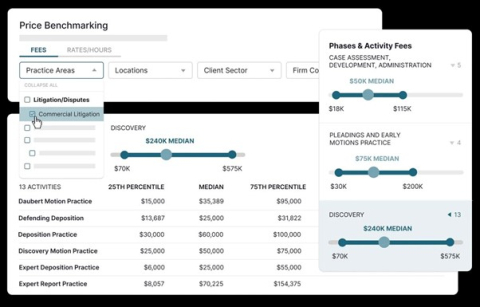
And this is where our partner PERSUIT helps. With them, selection goes beyond choosing a firm. It sets expectations up front and compares firms against them, so the commercial model and delivery approach are clear from the outset.
Then, continuously monitor legal spend
Setting expectations alone doesn’t hold the outcome in place.
Control starts to slip when those expectations are not revisited as the work progresses. Strong teams stay close to delivery while it is happening, rather than waiting until the invoice, when the outcome is already fixed.
They look for early signs that things are starting to move:
- changes in seniority mix
- scope extending beyond what was initially agreed
- delivery beginning to move away from expectations
These are a normal part of how legal work progresses. The difference is whether they are visible early enough to act on.
This is where our legal spend management software becomes important. It gives teams a way to stay close to those changes as they happen, rather than relying on retrospective review.
That means:
- tracking cost drivers while work is underway
- comparing expected vs actual delivery
- intervening before outcomes are locked
This changes how outside counsel is managed.
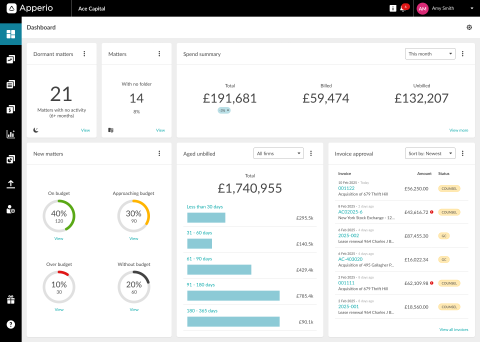
Essentially, effective outside counsel management comes down to how close you are to the work while it’s happening. The teams that do this well stay close to the work, and they can see when it starts to move and then have the opportunity to influence that spend.
Why “cheaper firms” isn’t the answer
The market has changed. Rate increases are showing up across all firm tiers. Discounts remain consistent. Pricing behaviour is more aligned than it used to be.
And this means that moving work on its own is no longer a reliable way to control costs.
At the same time, cost continues to be shaped by how work is delivered. Staffing decisions, scope development, and day-to-day execution all influence the final outcome in ways that are not visible at the point of selection.
So the focus has to move. Which firm looks cheaper at the outset is only part of it. But what drives cost during delivery, and whether there is enough visibility to act while work is still underway, becomes far more important.
Apperio helps legal teams stay close to how work is delivered, with continuous visibility into spend as it builds. If you want to understand what’s driving cost while work is still underway, you can find out more here.
Author:

Dominic Aelberry
CEO