Why invoice accuracy is the wrong metric for legal spend management

Invoice accuracy is one of the most widely used measures of control in legal spend management. It is also one of the least useful.
Recent benchmarking shows that companies allocate around half of legal spend to outside counsel and external providers, and in larger organizations that proportion is often higher. At that level, there is very little margin for getting the cost wrong.
And yet, most of the focus still sits at the point of invoice review. Bills are checked, guidelines are enforced, and compliance is high. In many cases, there is nothing to challenge. The invoice is accurate.
But the number is still higher than expected. And that’s because invoice accuracy only confirms that billing follows the rules. It does not show how the work was carried out, how it developed, or why the cost changed.
Key takeaways
|
Why many legal teams judge spend control by invoice compliance
Invoice accuracy tends to become the default indicator of control because it is easy to measure and straightforward to explain.
Invoice review is already embedded in existing governance. Legal e-billing systems, billing guidelines, and finance controls are already in place, and invoice review produces outputs that translate well beyond the legal team. Compliance rates, rejected entries, and adjustments give a clear record of oversight.
That makes it useful, particularly when legal needs to evidence discipline to the business.
The issue is what that visibility actually represents.
These measures show whether firms followed the agreed rules when they billed. But it does not capture how those rules played out in practice, or how decisions during delivery led to the final cost.
Most teams are aware of that. Even so, invoice accuracy tends to stay at the centre because it is one of the few measures that can be applied consistently across matters and explained without much difficulty. So it continues to be used as a proxy for control.
↪Further reading: 7 ways Apperio evolves legal spend management beyond e-billing

Why billing rule enforcement focuses on symptoms instead of the drivers of cost
Billing rules serve a clear purpose, and most legal teams rely on them heavily. They enforce agreed rates, prevent inappropriate charges, and flag entries that fall outside what has been approved. Used properly, they bring consistency to billing and reduce obvious leakage.
The problem is, they are applied after the work has been done.
By then, key decisions have already been made. The team has been set, the work has been carried out, and the level of effort is already reflected in the time recorded.
So the rules deal with what shows up on the bill, rather than what led to it.
What billing rules address vs what actually drives cost
|
What billing rules address |
What actually drives cost |
| Incorrect rates or entries |
Who does the work and how that mix changes |
| Charges outside agreed guidelines | How the scope expands once work is underway |
| Duplicate or clearly inappropriate billing | How much senior attention the work receives |
| Time recorded against tasks | How long the work takes to complete |
| Compliance with agreed terms | How often work is revisited or expanded |
Once you look at it this way, the limitation becomes more obvious.
Attention tends to settle on the invoice, because that is where the checks happen. Time is spent reviewing entries, querying lines, and making adjustments where needed. Meanwhile, the factors that actually determine cost happen elsewhere, building gradually as the work progresses.
Those two things are not happening in the same place. A matter can comply fully with billing rules and still exceed expectations. Everything may follow the agreed terms, and there may be nothing to challenge, but the final cost is still higher than expected.
Why invoice review is too late to influence financial outcomesBy the time an invoice is reviewed:
At that point, the only remaining action is to challenge specific entries. That may reduce the final number slightly. But it does not address the underlying cause. Invoice review can adjust the outcome. It cannot change how that outcome was created. |

Moving beyond invoice accuracy as a primary metric
Invoice accuracy stays in focus because it is easy to defend. But the measures that actually tell you something about cost start to appear earlier. They rely on continuous visibility into legal spend while the work is still in progress.
These concepts are already understood within most legal teams. The difference is being able to see them while the work is still in progress.
How legal spend starts to move earlier than expected
A final number on its own does not explain much. What’s key here is to see how that legal spend number builds. When spend is tracked as it accrues, you can see whether it is in line with expectations or starting to run ahead. In many cases, the final cost is already trending above or below expectation well before the work is complete.
When the work stops matching what was agreed
At the outset, there is usually a shared understanding of how the work will be delivered. But, as it progresses, that position can change without being formally reset. More senior time becomes involved. Additional steps are introduced. The level of effort increases.
None of these changes prompts a reassessment at the time. The increase in cost only becomes visible when the current activity is compared with what was originally agreed.
Where cost concentrates
Cost rarely increases evenly. It tends to build around specific points. A deeper line of analysis. A change in approach. A point where the work becomes more complex than first understood.
When spend is tracked at this level of detail, it is possible to see when costs begin to increase and what is driving it. That is the point where a decision can still be made.
What earlier financial visibility changesControl improves when legal teams can see how costs are developing while work is in progress. This allows them to:
With continuous visibility of legal spend, there is an opportunity to question or adjust the work before the cost is fixed. |
How leading legal teams are approaching this differently
The more sophisticated legal teams aren’t spending their time arguing over invoices. That’s a lagging indicator. By the time your team is reviewing a bill, the key decisions that influenced cost have already been made.
They focus earlier. On whether work is unfolding in line with what was agreed with their firms, and what to do the moment it doesn’t.
That sounds straightforward. But, in reality, it requires a different operating model.
It starts with how expectations are set and how seriously they’re treated
Scope, pricing, staffing. Familiar territory for any in-house team. What’s changed is the weight leading legal teams place on those decisions.
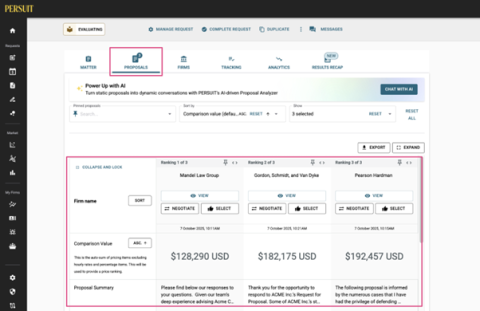
They treat the initial engagement with outside counsel as a set of assumptions that need to hold up under pressure. And that’s where platforms like PERSUIT change things for legal teams. Defining scope and pricing upfront becomes structured, comparable, and more closely tied to outcomes rather than inputs.
Then the focus moves to what is happening during delivery
This is where most teams lose control. The work runs. Decisions get made. Effort increases. And what’s missing is a clear view of whether that still lines up with what was agreed.
Leading teams stay close to this. They look at:
- whether the agreed staffing profile is still being followed
- whether senior time is increasing beyond what was planned
- whether the scope is expanding beyond what was agreed
And they look while the work is still underway.
↪Further reading: Partner stacking and other hidden multipliers: What to watch for in your legal WIP
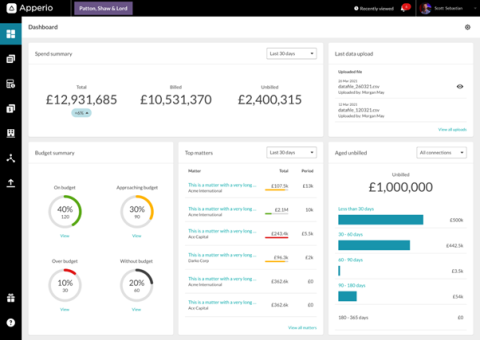
With something like Apperio (from PERSUIT) in place, the conversation moves to what is happening now on live engagements, and whether that activity still aligns with what was agreed at the outset.
Early signals provide opportunities to talk
The goal here is not to catch every discrepancy. It is to give legal teams early visibility so they can step in at the right moment.
Most cost movement comes from small, defensible decisions made during delivery by external counsel:
- a partner staying closer to the detail than planned
- an additional review layer introduced
- a timeline extending
Teams that manage this well act on the direction of travel while the work is still underway.
This is what connects planning to performance
What is emerging, especially with PERSUIT and Apperio’s integration, is a tighter feedback loop across the outside counsel lifecycle.
- expectations are set with structure at the outset
- execution is monitored as the work progresses
- adjustments are made while options are still open
That creates a continuous link between what was agreed and what actually happens. And that is what moves legal teams beyond retrospective spend management.
↪Further reading: Legal panel management: How to stay effective between review cycles

Invoice accuracy was never enough in legal spend management
Invoice accuracy tells you the bill follows the rules. But it doesn’t tell you whether the cost aligns with the original scope and expectations.
By the time an invoice is reviewed, the work is done, and the decisions that led to the cost are already in place. At that point, the focus moves to checking details, rather than understanding what drove the outcome.
That’s as far as it goes.
The teams that get closer control don’t start there.
They stay close to the work while it is happening. They watch how spend builds, where it starts to move, and what is driving that change. And they deal with it at that point, while there is still something to influence.
If you want to understand how your external legal costs take shape—and where they start to change—Apperio (from PERSUIT) shows you what’s happening while the work is in progress, and not when invoices arrive.
Author:

Dominic Aelberry
CEO