Legal billing data versus legal spend intelligence

Most enterprise legal teams already collect huge amounts of financial data around outside counsel spend. They can report on firms, rates, budgets, accruals, and invoice history in enormous detail. Many have spent years improving financial discipline around outside counsel management.
Yet the same teams still end up in difficult conversations about cost exposure that nobody expected six months earlier. For instance, a review becomes more extensive, internal pressure around timing increases, or a workstream continues for longer than expected.
And, on top of this, those changes are often difficult to fully understand through billing data alone. In fact, Thomson Reuters confirms that controlling outside counsel costs remains the top strategic priority for law departments, with the C-Suite identifying operational efficiency and cost reduction among their leading business goals.
So, by the time they appear clearly in invoices, accrual reporting, or revised forecasts, legal and finance teams are left trying to reconstruct how the original commercial assumptions stopped matching the work being delivered.
Key takeaways:
|
What do billing systems capture?
Billing systems already handle a huge amount of financial administration within legal departments. They are good at:
- invoice processing
- approval workflows
- accrual reporting
- rate validation
- outside counsel guidelines
- spend categorization
- historical reporting across firms and engagements
Over time, they also create a detailed financial record of how firms are managed across the business. This level of structure is already mature in many large organizations.
But billing systems were largely built to review financial compliance after work has already been completed. They were not designed to explain how the commercial position of an engagement developed over time.
A single invoice can compress months of delivery activity into a financial summary reviewed long after key commercial decisions were made. And the stakes of delays are rising: law firm rates averaged 9.2% increases in early 2025, meaning departments operating on quarterly reporting cycles are negotiating rate positions based on data that is already three months stale by the time it reaches them.
|
Invoice data may show:
|
But it doesn’t always explain:
|
The depth of the problem is laid bare by a key finding from a 2025 industry survey: while 50% of respondents believe they are being overbilled, 87% said their team spends only four hours or less per month reviewing bills.
Invoice data may show who billed, how much was charged, and whether guidelines were followed. But it does not always explain why staffing changed, how delivery expanded beyond the original assumptions, where cost exposure began increasing, or whether the engagement still reflected the commercial expectations agreed at the outset.
The invoice itself may be accurate while still providing only a partial explanation of how the final cost position developed.
↪Further reading: The pros and cons of legal invoicing and e-billing software
Billing data records spend. Legal spend analytics explains it

All of this points to a broader distinction between billing data and legal spend intelligence. Most billing systems are designed to process, validate, categorize, and report financial activity once it has already been recorded by a firm. But legal spend intelligence sits much closer to the commercial reality of outside counsel delivery.
Outside counsel cost escalation is driven more by operational gaps than rate increases. Unclear scoping, unmanaged changes, and staffing variability create significant budget overruns. These are precisely the types of intelligence that billing data alone cannot catch in time.
Legal spend intelligence focuses on questions that billing data alone cannot easily answer:
- Why is the financial position changing?
- Does current delivery still reflect the original commercial assumptions?
- Where is spend accelerating?
- How is staffing evolving across active engagements?
- Which engagements are becoming financially exposed before invoices arrive?
- How reliable are current accrual positions?
| Historical billing data mainly supports | Legal spend intelligence supports |
| Invoice validation | Forecasting confidence |
| Auditability | Accrual accuracy |
| Spend categorization | Outside counsel oversight |
| Financial reconciliation | Portfolio-level financial visibility |
| Commercial alignment throughout delivery |
How financial visibility changes outside counsel management
Financial visibility changes when firms and clients start discussing commercial decisions. Without it, many legal departments review delivery decisions indirectly through invoices, accrual adjustments, or revised forecasts after the engagement has already progressed.
But earlier visibility changes the timing of those discussions.
Conversations happen closer to the point where staffing, scope, or delivery decisions are being made. Firms can explain why an engagement is developing differently while there is still time to adjust expectations. Legal teams can assess those changes in context, rather than reconstructing them later through invoices and write-offs.
"The ability to look at WIP and ask, 'Why is this partner time?' — this is more than a cost concern."
Duncan Williams, General Counsel for Nuclear Fuel, Westinghouse — Apperio webinar, 2025
And over time, that changes the nature of outside counsel management itself.
This is where legal spend management software like Apperio from PERSUIT becomes increasingly useful. Instead of relying solely on periodic invoice review, legal and finance teams gain ongoing visibility into how financial exposure is developing across active engagements.
That becomes especially important across:
- AFAs
- panel management programs
- portfolio relationships
- cross-border engagements
- private equity transactions with compressed timelines and changing deal activity
In those situations, legal teams need a more current view of financial exposure across the wider portfolio, rather than reviewing individual invoices after the work has already been completed.
↪Further reading: What is Apperio Insights? GenAI legal spend management for faster decision-making
Why legal spend analytics is becoming part of legal operations

And that level of visibility becomes more important as the role of legal operations expands beyond invoice administration and reporting.
Legal operations is taking on broader financial responsibility
This level of visibility becomes more important as the role of legal operations expands beyond invoice administration and reporting. Legal operations teams are now expected to support much more than billing workflows and spend reporting, including financial forecasting, accrual confidence, outside counsel oversight, and financial reporting into the wider business.
According to the 2025 ACC Chief Legal Officers Survey, 41% of CLOs have received cost-cutting mandates, rising to 63% in companies with revenues exceeding $20 billion. That pressure lands directly on legal operations.
And the structural expectations are expanding in parallel: the CLOC 2026 State of the Industry Report found that financial management has become a key priority for 72% of legal operations teams. Outside counsel relationships are also becoming more commercially complex: AFAs are more common, panel arrangements are broader, and portfolio relationships now span multiple engagements across multiple jurisdictions.
Historical invoice reporting only captures a snapshot of that legal spend view.
↪ Further reading: The intersection of legal and financial strategy: Insights for the modern CFO
Reporting cycles and delivery cycles operate differently
Part of the difficulty comes from the way financial reporting and legal delivery operate on different timelines. Financial reporting still tends to operate in structured cycles. Monthly accruals. Quarterly forecasting. Invoice review after work has already been completed.
But outside counsel delivery operates continuously.
Almost 45% of CLOs say they're increasing their outside counsel spend in 2025 — a 17% jump from the previous year — driven largely by more complex litigation and investigations.
Commercial decisions continue throughout an engagement while staffing, scope, timelines, and business priorities continue changing in real time.
That creates a growing disconnect between:
- when delivery decisions are made
- when financial exposure becomes visible
- when legal and finance teams are expected to report confidently on spend
And as external legal spend increases, that delay becomes harder to manage.
Particularly where:
- firms are working across multiple connected engagements
- transactions are moving quickly
- legal and finance teams need current accrual positions
- cost exposure is changing week by week
↪Further reading: Why legal spend predictability breaks down (and what to do instead)
Why more legal teams are turning to legal spend intelligence
As a result, more legal departments are expanding beyond retrospective billing review and historical reporting.
They want a more current understanding of how external spend is developing while the work is still active.
This is where Apperio has become increasingly important for legal operations and finance teams managing large volumes of outside counsel spend.
Apperio gives teams ongoing visibility into:
- live accrual positions
- WIP exposure
- budget movement
- staffing development
- spend progression across active engagements
That visibility supports stronger forecasting, more reliable reporting, and better-informed outside counsel decisions across the wider portfolio.
More teams are now treating continuous spend visibility as part of operational management, rather than a reporting exercise completed afterwards.
↪Further reading: Why invoice accuracy is the wrong metric for legal spend management
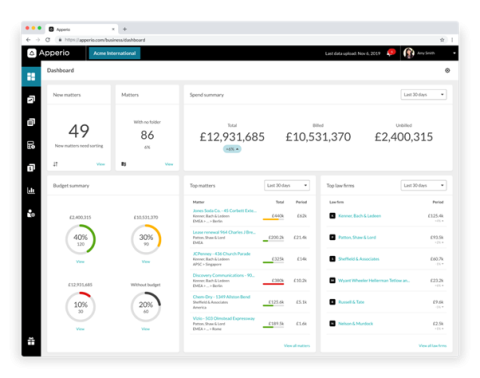
Connecting pricing expectations to live financial activity
All of these point to a broader change in how legal departments are managing outside counsel spend. Historically, commercial expectations and financial oversight have operated in separate stages. Scope, pricing assumptions, staffing expectations, and fee arrangements are agreed at the engagement stage. Financial review happens later through accrual reporting, invoice approval, and budget reconciliation.
And as external legal spend becomes larger and more complex, that separation becomes harder to manage.
Legal teams need a clearer financial view of whether delivery still reflects the commercial expectations originally agreed with outside counsel while work is still ongoing.
This is where Apperio from PERSUIT becomes particularly valuable.
By connecting engagement expectations with live financial activity, legal and finance teams gain a more continuous view of how external spend is developing across active engagements.
That includes:
- staffing behavior
- spend progression
- accrual position
- invoice validation
- movement against agreed commercial expectations
As a result, legal and finance teams can assess external spend against the commercial assumptions originally agreed with firms, rather than relying solely on retrospective reporting once costs have already accumulated.
Outside counsel discussions happen with more context. Forecasting becomes more reliable. And financial reporting becomes easier to support internally because teams are working from a more current understanding of external spend exposure across the wider portfolio.
Legal spend management is becoming more continuous
Legal departments have already spent years improving discipline around budgeting, billing, accruals, and financial reporting.
But the next challenge is reducing the gap between delivery decisions and financial understanding.
The teams managing this well tend to stay closer to the financial position of active engagements as work progresses. That gives legal, finance, and outside counsel teams more time to assess changes, adjust expectations, and maintain commercial alignment before cost exposure becomes harder to manage later.
And increasingly, that is where legal spend management is moving.
Away from retrospective financial administration alone, and toward ongoing financial management throughout the delivery of legal work.
If your team is looking to improve forecasting confidence, outside counsel oversight, and financial visibility across active engagements, Apperio, from PERSUIT, can help. Get in touch.
Author:

Dom Aelberry
CEO